Carcass estimate at weighing
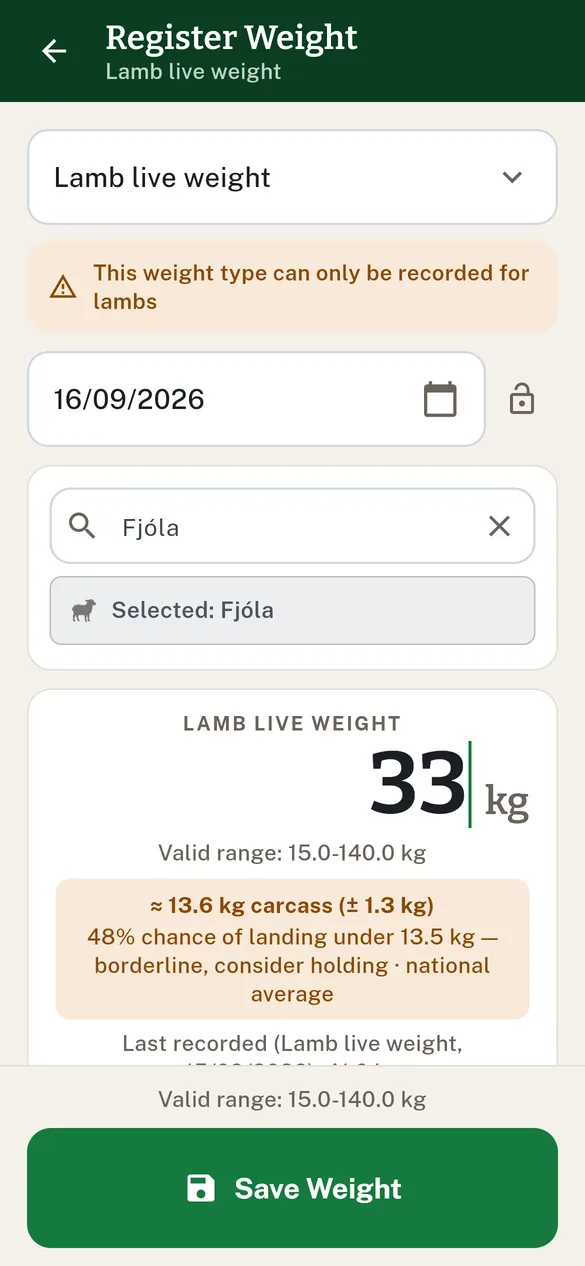
When you weigh a lamb in the autumn, the app shows — as soon as the weight is typed — what the lamb is likely to dress out at, and how likely the carcass is to land under 13.5 kg, where the slaughterhouses pay no premium.
Why 13.5 kg?
The early-delivery premium is high at the start of the season and falls week by week. But a carcass under 13.5 kg gets no premium at all, whichever week it goes. A lamb sent too light loses the whole premium, not part of it.
Of more than 335,000 lambs in LAMB customers' data, 12 in every 100 landed under the line. On some farms it was one in four.
How is it computed?
The farmer sees a live weight on the scale; the slaughterhouse pays on the carcass. The relation between the two is measured from the farm's own Fjárvís history — weighings and carcass weights of the same lambs, in the same week:
Carcass ≈ 0.44 × live weight − 0.9 kg, with an error of about ± 1.3 kg
From that the app computes the probability of landing under 13.5 kg and picks a colour:
| Colour | Chance of landing under 13.5 kg | Meaning |
|---|---|---|
| Green | under 10 % | Safe to send |
| Amber | 10–50 % | Borderline — consider holding |
| Red | over 50 % | Most likely no premium |
For reference, in the same week the lamb goes:
| Live weight | Share landing under 13.5 kg |
|---|---|
| 30–31 kg | 4 in 5 |
| 32–33 kg | just over half |
| 34–35 kg | 1 in 4 |
| 36–37 kg | 1 in 14 |
| 38 kg and up | almost none |
About 36 kg live is therefore the line at which a lamb is 90 % safe over the cliff.
"Based on your farm" or "national average"
Farms differ: dressing percentage (carcass ÷ live) runs from 40 % to 48 % between farms, which moves the 36 kg line by up to 3 kg. When your farm has enough Fjárvís history (at least 500 lambs with both weights) the app uses your own numbers and says "based on your farm (N lambs)". Otherwise it says "national average".
What to do with amber and red?
The estimate says how likely the lamb is to clear the line if it goes now. It does not say whether holding pays — that depends on that week's premium and on how fast the lamb grows. Rule of thumb: two weeks on good grass add about 4 kg live, roughly 1.7 kg of carcass. A 31 kg lamb in week 40, with the premium nearly gone, is rarely worth holding; a 33 kg lamb in week 37 usually is.
An estimate, not a promise
The error is about ± 1.3 kg. The app never shows a price, only a probability. The decision is yours.
Where does it appear?
Only under lamb live weight (the autumn weighing the send decision rests on) — not under birth weights or the weights of kept stock, where there is no slaughter decision behind the number. Iceland only.
See also Weight registration, step 8.